Digital Games Can Be Tools for Building Ideas
The best digital games for kids who need creativity and problem solving are not just colorful distractions. They give children systems to explore, tools to combine, puzzles to test, and worlds that respond to their choices. A strong digital game can help children design, revise, experiment, and explain their thinking. The value comes from active play, not passive screen time.
Creative Digital Play Gives Children Tools
A creativity-focused digital game should give children tools rather than only tasks. Building blocks, drawing systems, music makers, level editors, character creators, coding tiles, and open-ended worlds all invite children to make something. The child is not simply consuming a finished experience. They are changing the space and seeing what happens.
Tools matter because they support ownership. A child who designs a house, puzzle, song, creature, or route has to make choices and live with the results. They may revise the design, test a new idea, or explain why one version works better. That creative loop is where digital play becomes meaningful.
Problem Solving Works Best With Feedback
Digital games can be powerful problem-solving spaces because they give immediate feedback. A bridge collapses, a character cannot reach the goal, a code block runs in the wrong order, or a puzzle resets after a poor choice. The child sees the consequence quickly, then tries again. This makes experimentation feel natural.
The best feedback is clear without being humiliating. It shows what failed and leaves room for another attempt. Children learn that mistakes are information. When a game supports quick retries, the child can practice persistence without feeling stuck for too long.
Open-Ended Games Encourage Flexible Thinking
Open-ended digital games often support creativity better than games with only one correct path. A child may build a town, design a machine, arrange a scene, or invent a challenge for someone else to solve. The game becomes a sandbox for ideas. This kind of play encourages children to ask what else is possible.
Flexible thinking grows when children compare versions. They may ask whether a design is stable, whether a route is fair, or whether a character can solve the problem in a different way. The game becomes a safe place to test alternatives. That habit can carry into offline building, writing, and problem solving.
Puzzle Games Build Logical Sequencing
Many digital puzzle games help children practice sequencing. They must decide what happens first, what depends on something else, and how to adjust when the order is wrong. This is especially clear in coding-style games, path puzzles, and cause-and-effect challenges. The child sees that a solution is not just a guess; it is a chain.
Sequencing is valuable because it supports planning beyond the screen. Children use similar thinking when they build with blocks, follow a recipe, write a story, or organize schoolwork. A good digital puzzle makes that thinking visible and repeatable. The child learns by arranging actions and watching the outcome.
Design Games Teach Revision
Games that let children design levels, homes, outfits, machines, music, or stories can teach revision in a gentle way. The first version may not work as intended, but the child can change it. They can move a platform, swap a color, simplify a path, or add a missing clue. Revision becomes part of play instead of a correction from an adult.
This is one of the strongest benefits of creative digital games. Children can experiment without wasting materials or starting from scratch every time. They can compare versions quickly and develop a sense of improvement. That makes creativity feel active and manageable.
Collaboration Can Happen on Screens
Digital creativity does not have to be solitary. Children may build together, take turns designing challenges, explain a puzzle solution, or show a parent how a system works. When the game invites conversation, the screen becomes a shared workspace rather than a wall between people.
Adults can support collaboration by asking children to explain choices. What problem were you solving? Why did this design work better? What would you change next? These questions respect the child’s thinking and turn digital play into language practice.
Good Digital Games Avoid Constant Over-Rewarding
Some digital games bury children in coins, badges, flashing rewards, and urgent prompts. Those features can keep attention without building much thought. Creativity and problem solving need space. Children should have time to plan, test, and reflect without being rushed from one reward to the next.
A better digital game rewards progress through the work itself. The machine runs, the puzzle opens, the city functions, or the design looks closer to the child’s idea. That kind of reward is slower but deeper. It teaches satisfaction in solving and making.
Screen Time Quality Matters
Not all screen time asks the same thing from a child. A passive video, a reflex-heavy game, a creative sandbox, and a logic puzzle all use attention differently. Parents do not need to treat every digital experience as equal. The important question is what the child is doing with their mind while playing.
High-quality digital games usually invite choice, persistence, explanation, and transfer. The child can describe what they made, what failed, what changed, and what they want to try next. If the game produces that kind of thinking, it is doing more than filling time.
Balance With Offline Play Makes Digital Learning Stronger
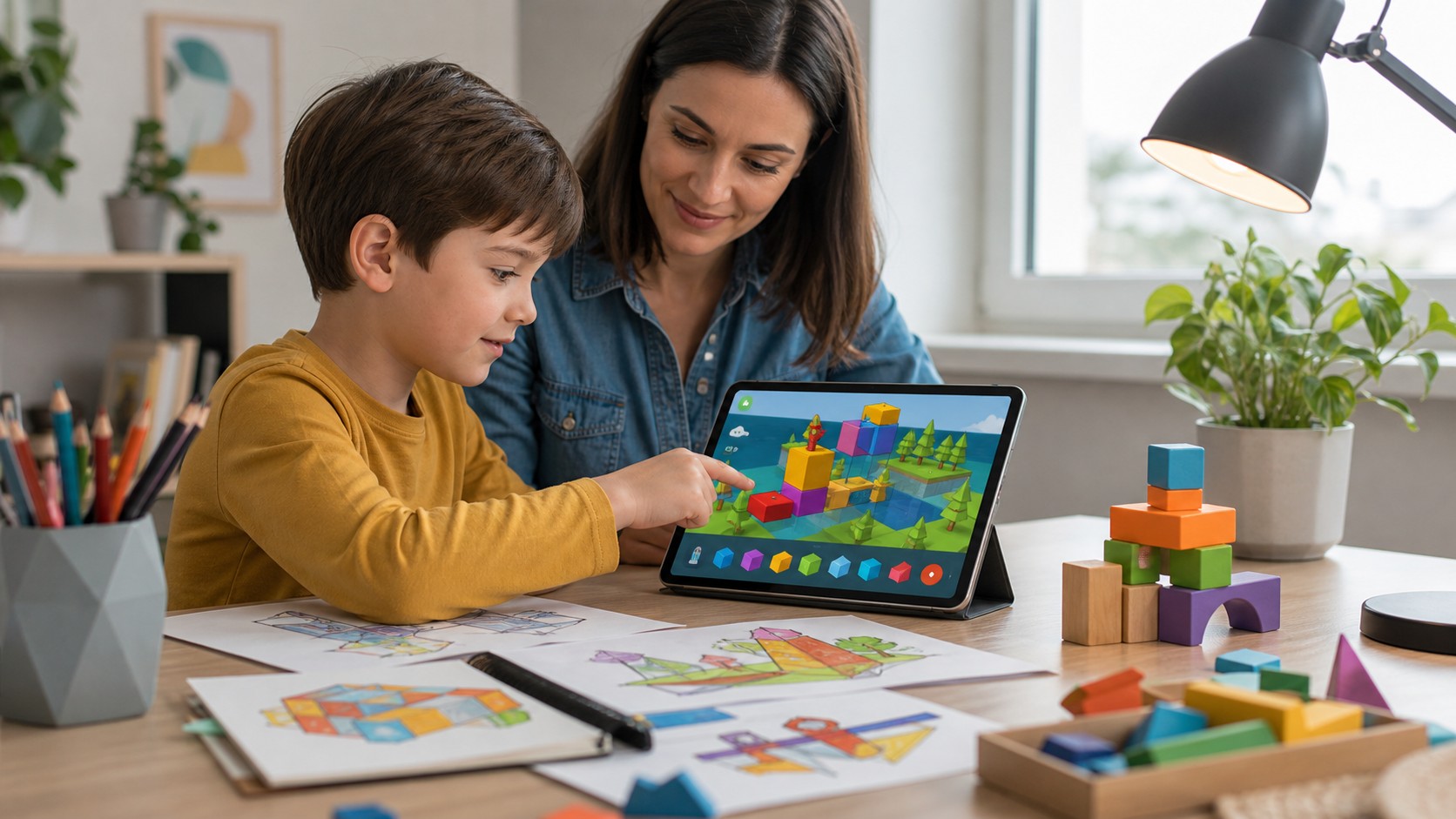
Digital creativity becomes stronger when it connects with offline materials. A child who builds a bridge in a game may try a block bridge later. A child who designs a digital creature may draw it on paper. A child who solves a route puzzle may build a similar path with toys. The screen can become a starting point instead of the whole experience.
Parents can encourage this connection lightly. Ask whether the child wants to sketch the design, build a version with blocks, or explain the solution at dinner. These small bridges help digital play support broader creativity. The goal is not to reject screens, but to make them part of a richer play diet.
Choosing Digital Games With Care
A strong digital game for creativity and problem solving should have clear controls, age-appropriate content, meaningful choices, and room to retry. It should not depend entirely on ads, pressure timers, or constant purchases. Children need enough freedom to explore without being pushed toward every next click.
Before choosing a game, look at what children actually do inside it. Are they building, testing, explaining, designing, sequencing, or collaborating? If the answer is yes, the game may support real thinking. If the main activity is tapping through rewards, it probably offers less value than it appears.
The Best Digital Games Ask Kids to Make Decisions
A digital game supports creativity when children have to make decisions that affect the outcome. They might choose how to build a level, where to place a tool, what sequence to run, or how to solve a puzzle with limited pieces. Those decisions matter because they force the child to think about cause, effect, and intention.
Decision-making also helps separate meaningful digital play from passive screen time. If a child can explain why they changed a design or selected one solution over another, the game has invited real thought. The screen is not simply holding attention. It is giving the child a place to test judgment.
Creative Games Should Welcome Revision
Creativity rarely arrives perfectly on the first attempt. A digital game that supports creativity should make revision easy and normal. Children need to move a piece, undo a step, test a new path, change a color, or rebuild a section without feeling that they have failed. Revision is where creative thinking becomes stronger.
This is one advantage of well-designed digital tools. Children can experiment quickly, compare versions, and learn from results without wasting supplies or starting over completely. When a child improves a design because they noticed a problem, the game is teaching more than decoration. It is teaching an iterative creative process.
Problem Solving Needs the Right Amount of Friction
A problem-solving game should not remove every obstacle, but it should make obstacles understandable. If a puzzle is too easy, children may tap through without thinking. If it is too confusing, they may quit. The best games create productive friction: enough challenge to require thought, but enough clarity to invite another attempt.
Productive friction builds persistence. Children learn to pause, test, and adjust rather than expecting instant success. A good game supports that mindset with clear feedback and quick retries. The child begins to see difficulty as part of the puzzle, not as a sign that they cannot do it.
Digital Creativity Can Become Social
Children often want to show what they made, and that sharing can deepen the learning. A child who explains a digital house, level, machine, or character has to organize ideas in language. They may describe the problem they solved, the change they made, or the part they still want to improve. This turns screen activity into communication.
Parents and siblings can participate without taking over. Ask the child to give a tour, describe the hardest part, or teach someone else how the tool works. These conversations help children value their own process. They also make digital play less isolated and more connected to family life.
Choosing Digital Games Requires Looking Past the Packaging
Many games claim to boost creativity or problem solving, but the actual play may be shallow. Parents should look past the label and watch the activity. Is the child making, testing, sequencing, designing, or explaining? Or are they mostly collecting rewards and following prompts? The difference matters.
A useful digital game should respect the child’s attention. It should not bury the creative work under ads, pressure timers, or constant purchase prompts. Children need room to think. If the game gives them that room and responds meaningfully to their choices, it is far more likely to support real growth.
The Best Digital Projects Have a Before and After
Creative digital play becomes easier to evaluate when a child can point to a before and after. The level was confusing, then it became clearer. The machine failed, then it ran. The character looked unfinished, then it matched the idea better. That visible change shows that the child revised something with intention.
Parents can ask about that change without turning the play into homework. What did you improve? What was not working before? What would you change next time? These questions help children see the value of their own process. The game becomes a place where effort leaves evidence.
Problem Solving Improves When Children Explain the Rule
Many digital puzzles have an underlying rule that children slowly discover. A door opens only after a sequence, a bridge works only with support, or a code block only runs after another step. When children can explain that rule, they move from trial and error toward understanding.
This is why explanation matters so much. A child may solve a puzzle by luck once, but explaining the rule shows deeper learning. Adults can listen for words like because, first, then, if, and next. Those words reveal the logic forming underneath the play.